The Ornithological Society of the Middle East, the Caucasus and Central Asia is a registered charity (no 282938) and exists to collect, collate and publish data on all aspects of the Ornithology of the Middle East, the Caucasus and Central Asia region.
OSME members receive
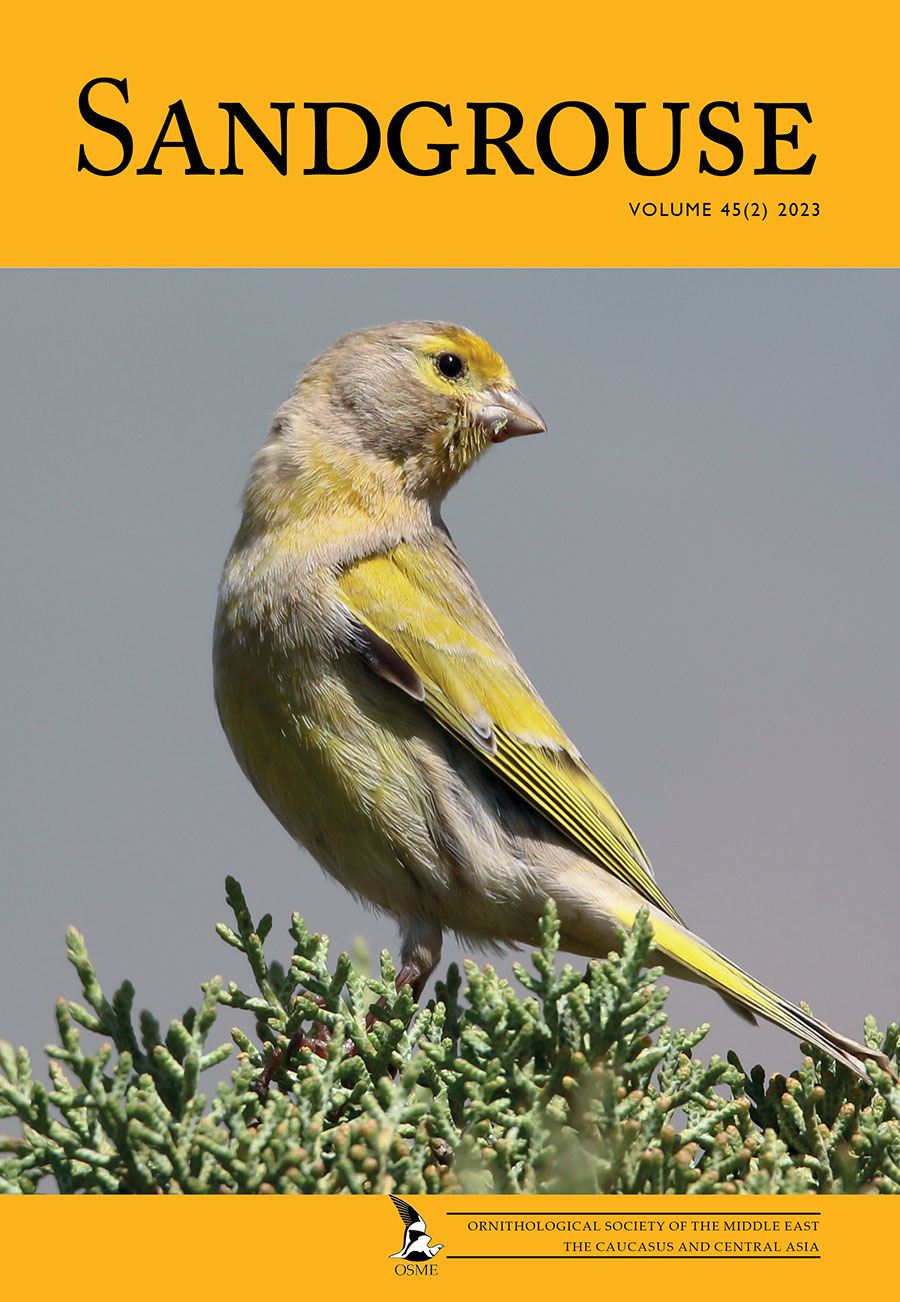
Our journal Sandgrouse
which....
- publishes short notes on identification and first records for the region.
- publishes papers on bird distribution, behaviour, ecology and conservation issues.
- provides bird and conservation news from the region.
- lets you know about the best birding sites in the region.
- provides a comprehensive round up of bird sightings in the OSME region.
Sandgrouse is published twice a year in spring and autumn.
Join today
Additional support for White-headed Duck conservation in Kazakhstan
Discover the natural wonders of Kazakhstan and support conservation
OSME Raffle 2013
Summer Meeting
35th Annual General Meeting
New Council members request
Conservation and Research page updated
Request for recordings of bird sounds
OSME Summer Meeting 2012……
Minutes of the 34th Annual General Meeting held on Saturday 7th July 2012 at the premises of the British Trust for Ornithology, Thetford, Norfolk, UK
Additional support for White-headed Duck conservation in Kazakhstan
To supplement the money raised by the 2012 Raffle, OSME is auctioning an original watercolour painting of White-headed Duck by renowned wildlife artist, Martin Woodcock. Bids in excess of £350 are invited and full details are provided on the linked pdf. This is a unique opportunity to help conservation of one of the region’s globally threatened birds and obtain an outstanding piece of artwork. As always, the more money we raise, the more research and conservation work we will be able to support.
Click here to see the PDF file
Discover the natural wonders of Kazakhstan and support conservation
ACBK, BirdLife in Kazakhstan, is running a series of tours which will enable visitors to see many of the enigmatic and important species of this fascinating country. The profits from the tours will be used to support ACBK's ongoing work to protect the natural riches of Kazakhstan. If you've been thinking about visiting Kazakhstan, now's your opportunity!
For more information including tour itinerary, dates etc click here to see a PDF file.
OSME Raffle 2013
This year’s raffle will be raising funds to support work by Nature Iraq on the globally endangered Basra Reed Warbler Acrocephalus griseldis, one of the most threatened passerines in the OSME region. The species is classed as endangered due to its small population size, estimated at 2,500 to 9,999 individuals, which is believed to be declining. The main breeding population is in Iraq, notably the Mesopotamian marshes of south-east Iraq. The species migrates south through Saudi Arabia and Kuwait, before wintering in north-east and east Africa, Since the 1950s there has been considerable loss of its shallow, marshy wetland habitat due to large-scale hydrological projects throughout the Euphrates and Tigris river-basins. More recently, the draining of the Mesopotamian marshes resulted in a huge loss of good quality breeding habitat which must have accelerated population declines. The key threat to the conservation of the species remains habitat loss and degradation, both on the breeding and wintering grounds.
In 2014, Nature Iraq, the BirdLife partner, are planning to undertake much needed research to learn more about the breeding behaviour and requirements, and to use this information to develop a species action plan and identify conservation actions. OSME will directly support ornithologists from Nature Iraq to undertake innovative research using remote nest cameras to monitor nest survival and breeding success of Basra Reed Warblers. The results will be used to inform future habitat restoration projects.
This year’s raffle prizes are:
1st Opticron Imagic BGA SE 8x42 binoculars (value £439)
2nd Naturetrek holiday voucher (value £250)
3rd Birdguides Breeding Birds of the Western Palearctic DVD (value £75)
4th Country Innovtion New Venture waistcoat (value £65)
5th Helm/Poyser books to the value of £50
6th Birdguides Guide to British Birds DVD (value £40)
Tickets, costing £5 for a book of five, are now on sale and can be obtained from the Treasurer, OSME, c/o The Lodge, Sandy, Bedfordshire SG19 2DL. However, if you are unable or would prefer not to buy tickets but would like to support this important project, you can make a donation to OSME by sending a sterling cheque to the Treasurer or by debit/credit card via the OSME website – www.osme.org. If you wish to use the website facility, from the Join OSME page of the site, click on the Use credit card link in the side bar and enter the amount you would like to donate in the appropriate box and then click Submit your subscription. This will take you to the checkout page where you can delete the subscription entry by setting it to zero and pressing Recalculate. Then click on Go to Payments to enter your details and complete the transaction. If you are a UK taxpayer, the value of your donation can be increased at no cost to yourself by Gift Aiding it. If you have not yet completed a Gift Aid form, a form can be obtained from the Treasurer.
Summer Meeting
Saturday 6th July 2013
Monitoring Bird Populations in the OSME Region
Programme
11.00 Introduction – Geoff Welch, Chairman
11.10 Latest update on the BTO satellite-tagged cuckoos. Paul Stancliffe
11.30 Numbers and distribution of Macqueen’s Bustard Chlamydotis macqueenii in the Kyzylkum desert, Uzbekistan - preliminary findings. Maxim Koshkin
12.15 Batumi Raptor Count: enabling a sustainable future for an important raptor migration bottleneck. Wouter Vansteelant
13.00 Lunch break
A range of sandwiches and drinks will be available.
14.00 35th Annual General Meeting
14.30 Northern Bald Ibis – holding on in Syria, Turkey & Arabian flyway? Chris Bowden
15.15 Short break
15.30 The Importance of Central Asia for the endangered White-headed Duck. Rob Sheldon
16.15 Hunting and energy: their impacts on the soaring birds of the Middle East and BirdLife’s work to save the Rift Valley/Red Sea flyway. Marcus Kohler
17.00 Drawing of raffle and closing remarks
17.15 Close of meeting
Dinner We have again arranged a meal at the Mulberry restaurant in Thetford after the meeting. We hope you will be able to join us. Please contact Ian Harrison – 01545 571022 or ianbirds@gmail.com – from whom further details can also be obtained.
OSME RAFFLE 2013 Support the endangered Basra Reed Warbler conservation project in Iraq! All profits from this year’s raffle will be given to Nature Iraq which is administering the project.
SUNDAY 7TH JULY 07.30 – 10.30
JOIN US ON A BRECKLAND BIRDING TRIP
Possibilities of seeing Eurasian Stone-curlew, Woodlark, Firecrest. Contact Ian Harrison (details above) to reserve a place and to obtain more details. We hope you can join us!
The Meeting will be held at:
The British Trust for Ornithology
The Nunnery
THETFORD, Norfolk
IP24 2PU
Getting to the BTO
By Rail to Thetford Station Thetford is on the Birmingham-Norwich line. From London travel via Cambridge. Taxis are available at Thetford station.
By Road The Nunnery is on Nuns’ Bridge Road which is off the A134 to the south of the town. To obtain a map of the area visit www.multimap.co.uk and enter postcode IP24 2PU. There is a large car park at The Nunnery.
Accommodation can be found in Thetford, Bury St.Edmunds, Norwich, Newmarket, Barton Mills.
35th Annual General Meeting
Copies of the draft Minutes of the 34th AGM and the Accounts for 2012 will be available at the meeting. The draft Minutes were also posted on the website in August 2012 where they can still be viewed. If you would like copies in advance please write to the Secretary, OSME, c/o The Lodge, SANDY, Bedfordshire, SG19 2DL, UK or e-mail: secretary@osme.org
Agenda
- Apologies for absence
- Minutes of the 34th Annual General Meeting (7th July, 2012)
- Matters arising
- Presentation and adoption of the Accounts for 2012
- Appointment of accounts examiner for 2013
- Election of Officers
- Any other business.
Vice-Presidents (10 year term)
The following are continuing in office:
Ramaz Gokhelashvili (2016); Sherif Baha el Din (2016); Ali bin Amer Al Kiyumi (2016); Dan Alon (2017); Dr Akram Eissa
Darwish (2017); Ali Adhami Mirhosseyni (2018); Sergey Sklyarenko (2018); Azzam Alwash (2019); Melis Charalambides (2020).
Nominations: Nabegh Ghazal Aswad
Council Members (Trustees elected for a 5 year term)
The following are continuing in office:
Nick Moran (2015); Robert Sheldon (2014); Helen Demopoulos (2016); Chris Hughes (2017); Phil Cannings (2017); Sal Cooke (2017).
The following will be ending their term of office at this year’s AGM: Geoff Welch, Ian Harrison, Mike Blair.
Currently Co-opted Council Members (appointed by the elected Council) John Warr (Treasurer & Membership); Effie Warr (Sales & Distribution); Peter Cowan (Editor, Sandgrouse); AbdulRahman Al Sirhan (Website Manager); Chris Lamsdell (Advertising); Christine Booth (Conservation & Research Fund).
Nominations: Tristan Reid, Matthew White
Further nominations should be sent to the Secretary (e-mail: secretary@osme.org) to arrive as soon as possible. Council would be pleased to welcome any members who can assist with maintaining OSME as one of the premier regional bird clubs.
OSME is a registered charity (no. 282938)
www.osme.org
New Council members request
OSME relies on its volunteer Council members in order to operate efficiently and we are currently seeking new members to join Council. Council members serve for 5 years and Council meets formally three times a year but the majority of OSME business is carried out via email. Whilst a knowledge of the birds of the region is desirable, the most important attributes of Council members are having the time and enthusiasm to actively help maintain and promote the Society and good communication skills. If you would like help maintain OSME as one of the premier regional bird clubs, please contact me.
Geoff Welch
Chairman of Council
chairman
Conservation and Research page updated
The Conservation and Research Fund Sub-committee which consists of Christine Booth (Chair), Richard Porter (Middle East),
Michael Brombacher (Central Asia), Vasil Ananian (Caucasus) and Rob Sheldon (Scientific Adviser) has just published a new
conservation page at OSME website.
It includes a new Grant Application Form which is available here
to download.
Request for recordings of bird sounds
Bloomsbury are doing an eBook of Birds of the Middle East (Porter & Aspinall (2010) and it is planned to include bird sounds. Most of these have been obtained but there are still a few outstanding and if anyone can help they would be really grateful. As well as an acknowledgement there will be a small fee for any that are used, but details haven't yet been worked out.
If you can help please contact Richard Porter - RFPorter@talktalk.net
Below are the vocalisations still needed (all should have been recorded in the Middle East).
Caspian Tit Poecile (lugubris) hyrcanusSee-see Partridge Ammoperdix griseogularis
Socotra Cormorant Phalocrocorax nigrogularis
Spur-winged Lapwing Vanellus spinosus
Sooty Falcon Falco concolor
White-eyed Gull Larus leucophthalmus
Armenian Gull Larus armenicus
White-cheeked Tern Sterna repressa
Yellow-eyed Pigeon Columba eversmanni
Laughing Dove Spilopelia senegalensis
Namaqua Dove Oena capensis
Grey-bellied Cuckoo Cacomantis passerinus
Pharaoh Eagle Owl Bubo ascalaphus
Arabian Spotted Eagle Owl Bubo (africanus) milesi
Sykes’s Nightjar Caprimulgus mahrattensis
Sind Woodpecker Dendrocopos assimilis
Turkestan Shrike Lanius (isabellinus) phoenicuroides
Iraq Babbler Turdoides altirostris
Afghan Babbler Turdoides (caudata) huttoni
Pleske’s Ground Jay Podoces pleskei
Hypocolius Hypocolius ampelinus
Turkestan Tit Parus (major) bokharensis
Basra Reed Warbler Acrocephalus griseldis
Variable Wheatear Oenanthe picata
Kurdistan Wheatear Oenanthe xanthoprymna
Saxaul Sparrow Passer ammodendri
Afghan Scrub Sparrow Passer (moabiticus) yatii
Dead Sea Sparrow Passer moabiticus
Asian Desert Sparrow Passer (simplex) zarudnyi
Arabian Golden Sparrow Passer euchlorus
Radde’s Accentor Prunella ocularis
Syrian Serin Serinus syriacus
Eurasian Crimson-winged Finch Rhodopechys sanguineus
Western Cinereous Bunting Emberiza cineracea
OSME Summer Meeting 2012……
The 2012 Summer Meeting and AGM on Saturday 7 July were again held at the BTO headquarters in Thetford and attended by 43 members and guests. The day had the theme of migration and the first speaker, Paul Stancliffe from the BTO, set the scene by giving a comprehensive overview of the increasing use of technology to reveal the secrets of the migrations of several species. The BTO is focussing on a range of species, the majority of which are in serious decline and where it is important to understand where the problems driving the declines are actually taking place – on the breeding grounds, wintering grounds or en route? Only once this is understood will it be possible to develop appropriate conservation actions. The two main techniques being used are geolocators and miniaturised satellite tags. Geolocators can only be used on species which return to the same breeding area from year to year as the birds need to be recaptured and the data downloaded for analysis. By contrast, satellite tags can be used on any species and provide information on where individual birds are for as long as the tags transmit. To date geolocators have been used successfully on Common Nightingales Luscinia megarhynchos, Common Swifts Apus apus and European Nightjars Caprimulgus europaeus and satellite tags on Common Cuckoos Cuculus canorus. In all cases the results are confirming the importance of western Africa, especially Guinea and Congo, as a wintering area for these species, something we knew or suspected from ringing recoveries. However, what the data is also suggesting is that Liberia may be an important staging ground for many species, especially on their northward migration. The satellite tagging has also highlighted a ‘bottleneck’ site for Common Cuckoos in northern Italy; the fact that birds from the same breeding area may use different routes on their southward migration; and birds from different breeding areas use different routes to reach the same wintering area. As technology continues to develop, the weight of satellite tags is decreasing which will make it possible to tag a wider range of species. The other significant element of the BTO’s work is that the results from the research, especially the satellite tagging, are being made available via the internet – http://www.bto.org/science/migration/tracking-studies/cuckoo-tracking/. This is proving to be an especially effective means of engaging the general public in bird research and conservation. Whilst the BTO’s work is concentrated on species that breed in the UK and winter in Africa, the techniques are clearly applicable to similar studies of species in the OSME region. Satellite tagging has already been used to great effect to understand the migration routes and wintering areas of Critically Endangered Sociable Lapwings Vanellus gregarius and Northern Bald Ibis Geronticus eremita but the scope for studying other species is enormous. Technology will never replace ringing as the techniques provide different types of information, rather they complement each other and now provide researchers and conservationists with a much greater range of tools for addressing the problems facing so many species throughout the world.
The second speaker of the morning was OSME Council member Helen Demopoulos who gave a fascinating talk about Lebanon where she worked for A Rocha for 15 months in 2007 and 2008. After outlining some of the difficulties of living and working in a country recovering from a long period of unrest, Helen described how the geographical location and topography of Lebanon make the country of outstanding importance for migratory soaring birds. Every year millions of storks, pelicans and raptors pass through in spring and autumn and in several areas birds are concentrated at ‘bottleneck’ sites which makes them easier to monitor but also renders them susceptible to uncontrolled illegal hunting. A key element of A Rocha’s work has been to identify such ‘bottleneck’ sites and other areas of global importance for birds. Where the appropriate criteria are met, such sites have been designated Important Bird Areas (IBAs) by BirdLife International. To date 15 IBAs have been identified, 10 of them being ‘bottleneck’ sites. The other sites are important for globally threatened species such as Syrian Serin Serinus syriacus and Audouin’s Gull Larus audouinii and for their communities of restricted-range species. During IBA fieldwork, three new species for Lebanon were discovered – Bar-tailed Lark Ammomanes cinctura, Scrub Warbler Scotocerca inquieta and Eastern Mourning Wheatear Oenanthe lugens. Additionally the status of several species was re-evaluated for example Eurasian Blue Tit Cyanistes caeruleus is now known to be a common breeding species, Great Spotted Cuckoo Clamator glandarius possibly breeds and European Robin Erithacus rubecula was found to be a common wintering species. A Rocha has also been instrumental in promoting a renewed interest in the traditional hima system – community-based protection and management of natural resources – to help conserve IBAs. There is clearly still much to be discovered in Lebanon and the country offers many opportunities to visiting birdwatchers though the migration will possibly be the greatest attraction. As Helen said in the title of her talk, rather than just being a country with IBAs, Lebanon is, in fact, an Important Bird Country!
The afternoon session started with a presentation on Bird Survey and Ringing in the Western Desert, Egypt, 2010 which was given by Professor Przemyslaw Busse, Krzysztof Stepniewski and Matt White. Professor Busse provided an overview of the development of coordinated networks of ringing sites in Europe, initially focussed along the Baltic, then extending into southwest Europe and finally also taking in southeast Europe and the western fringes of the OSME region. In relation to OSME, initially work was carried out in the Sinai but since 2006 the focus has shifted to the oases of the Western Desert of Egypt, approximately 180 km west of the Nile Valley. Matt White went on to describe the main study areas – Lake Abu Yasser and Lake El Marun. Lake Abu Yasser is a small saline lake surrounded by black desert, low intensity agriculture, mudflats and palm plantations. Lake El Marun is surrounded by steppe escarpments, tamarisk scrub, irrigated alfalfa and fruit and palm plantations. Studies at these sites have been a combination of vantage points counts and ringing. To date 83 species have been recorded, 54 at Abu Yasser and 74 at El Marun, with the commonest being Spanish Sparrow Passer hispaniolensis, Yellow Wagtail Motacilla flava and Western Cattle Egret Bulbulcus ibis. Of 30 species of passerine migrant, Willow Warbler Phylloscopus trochilus was the most numerous. Finally, Krzysztof talked about the ringing studies in more detail. A study supported by OSME in 2010 looked especially at habitat preferences of migrants and found that the tamarisk scrub and alfalfa were the most important as these habitats provided plentiful food for migrants as shown by measuring fat scores. Species such as Sedge Warbler Acrocephalus schoenobaenus rapidly increased their weight in order to be able to cross the Sahara non-stop while increases were less in Eurasian Reed Warblers A scirpaceus as this species feeds en route. Orientation tests showed that most migrants selected headings facing west, northwest or southwest, the latter being in the direction of Lake Chad which is known to be an important wintering and staging area for many species. Clearly there is a lot more still to be learned.
The fourth talk of the day was by Stoyan Nikolov, from the Bulgarian Society for the Protection of Birds (BSPB, BirdLife in Bulgaria) who is the Project Manager for a new European Union LIFE+ Nature project entitled Egyptian Vulture Conservation Challenges along the Eastern Mediterranean Migration Flyway. In the last 50 years, the global population of Egyptian Vulture Neophron percnopterus has decreased by >50% and the species is now classed as Endangered. The main threats to the species are electrocution, secondary poisoning, direct persecution, disturbance at the breeding grounds and habitat loss. The species uses two migratory flyways, a western one via Gibraltar to western Africa and an eastern one through the OSME region to Chad. To help understand how best to conserve the species since 2009 a small number of birds breeding in Bulgaria have been fitted with satellite transmitters. Most interesting, but also depressing, one bird travelled 5,000 km to Chad but was then killed by local people who saw the transmitter and thought the bird was a ‘bad magician’! Such persecution of tagged birds has been recorded in several parts of Africa and the Middle East which is a great pity as tagging generates a huge amount of vital data but conservationists now have to weigh up the risk of actually endangering the birds they are attempting to study. Whilst much of the LIFE+ project is focussed on conserving the small breeding population of Egyptian Vultures in the Balkans there are clearly things that could be done to help safeguard the species while it is migrating through the OSME region. Future plans include tagging more birds, further expeditions to study birds along the eastern flyway, organising an international conference in 2013 and developing a flyway action plan. There are several opportunities for conservation bodies and active members in the OSME region to assist with some of this work.
The final talk of the day was on Migration through Abu Dhabi, United Arab Emirates given by OSME Council member, Nick Moran. This demonstrated how regular birding and record keeping by Nick and colleague Oscar Campbell can be analysed to show the phenology of migrants. Between 2007 and 2012, Nick and Oscar covered a range of sites in Abu Dhabi on a regular basis and systematically recorded the species and numbers they observed. Although not scientifically rigorous, the analysis carried out to date shows close parallels to similar studies in Israel and Jordan. Abu Dhabi is already a popular birding location and Nick’s presentation provided a taster for prospective first-time visitors. In relation to spring migration, March is the month with the greatest diversity of species and is the peak time for seeing Pied Wheatear Oenanthe pleschanka, Menetries’s Warbler Sylvia mystacea and Daurian Shrike Lanius isabellinus. In April the Daurian Shrikes are replaced by Turkestan Shrikes L phoenicuroides, numerous races of Yellow Wagtail, Common Redstart Phoenicurus phoenicurus, Common Nightingale, Ortolan Bunting Emberiza hortulana and European Roller Coracias garrulus. In May, the key species are Upcher’s Warbler Hippolais languida, European Nightjar, Red-backed Shrike Lanius collurio, Spotted Flycatcher Muscicapa striata, Common Whitethroat Sylvia communis and Marsh Warbler Acrocephalus palustris. Added to these there is a wide range of less numerous migrants and always the chance of rarities! Nick was keen to emphasise that there is a lot more analysis that could be done with his and Oscar’s records and plenty of scope for more detailed studies but his talk highlighted the value of keeping systematic records when out birding and, most importantly, making the data available for scientific study rather than having it ‘locked away’ in a forgotten notebook.
During the 34th Annual General Meeting, the following changes to OSME’s Vice-Presidents and Council members were announced. Imad Atrash and Dr and Mrs Ramadan-Jaradi retired as Vice-Presidents after completing 10 years in office and Guy Kirwan retired from Council after 5 years in office. All were thanked for the important contributions they have made to promoting and assisting with the running of the Society. The following were elected on to Council – Sal Cooke, Phil Cannings and Chris Hughes.
Plat 1 Effie Warr being presented with her painting of Basalt Wheatear by OSME Chairman, Geoff Welch (© Geoff & Hilary Welch)
The day had a special end when Effie Warr who, together with her husband John, has made and continues to make an outstanding contribution to the running of OSME, was presented with a specially commissioned painting by Michael Warren of Basalt Wheatear Oenanthe lugens warriae – see plate 1. This distinct form of Mourning Wheatear was recently recognised as a separate subspecies by Hadoram Shirihai and Guy Kirwan and given the name warriae in honour of the tremendous contribution Effie has made to ornithological research in the Middle East.
The day was rounded off by an excellent meal in The Mulberry in Thetford which allowed OSME Council, members and friends to continue discussions in a relaxed atmosphere, renew old friendships and create new ones. A great end to a great day.
Geoff Welch
Chairman of Council
……and Breckland Bird walk
Members of OSME were treated to great views of some Breckland specialities on the morning of Sunday 8 July, following the Summer Meeting/AGM the previous day. Chris Mills of Norfolk Birding (http://www.norfolkbirding.com/) kindly led a tour of heathland and plantation sites, and the weather cooperated nicely. The first stop was an anonymous patch of open ground. Despite the predominance of tall grasses, two Stone-curlews obligingly stood out on some turf in the foreground to be viewed and appreciated. From birders in the group familiar with North Africa, we learned that these birds can form large wintering flocks in Morocco; it is also a familiar species over much of the OSME region. Encouraged by this early encounter, the group then moved on to have a look for Woodlarks. This involved a drive, a walk down a forest track and then a good look at an area cleared of trees. The tree stumps from the clearing operation had been collected into parallel lines stretching across the now open area. Each line of piled up stumps had become populated with shrubs and small trees. Early signs were positive: Whitethroats used the perches provided by the tangled tree roots to launch into song flights, a flock of Linnets settled in a small holly tree, and a pair of Yellowhammers busily ferried food to their unseen nestlings. At the edge of the forest on the far side of the site, a Turtle Dove sat in branches silhouetted against the sky. Then a Woodlark appeared on one of the distant lines of tree stumps. Whilst this viewing clearly meant something to those more familiar with the species, a much better view of two birds a few minutes later allowed a fuller appreciation of some this species’ characteristic features – the white supercilium, relatively short tail and signs of a crest. Unfortunately what some would consider to be the best feature of Woodlarks, their song, was only briefly on offer, though some compensation was provided by a singing Tree Pipit. And a Sparrowhawk added a predatory note to this otherwise peaceful scene, grabbing something tasty on the ground alongside the tree stumps, then spreading its wings around its catch while it disembowelled its breakfast. Round our feet, Brown Silver-line moths were in profusion, and a rather worn Red-necked Footman was identified. All in all, the morning provided a wonderful insight to some of the special wildlife and habitats of the Breckland. Our thanks to Chris Mills from Norfolk Birding for his enthusiastic and expert guiding and to Nick Moran, of the OSME council, for organising the excursion.
Daniel Owen (OSME member)
Minutes of the 34th Annual General Meeting held on Saturday 7th July 2012 at the premises of the British Trust for Ornithology, Thetford, Norfolk, UK
Members Present –. Dawn Balmer, Mike Blair, Christine Booth, Phil Cannings, Mick Carroll, Sal Cooke, Elaine Cowan, Peter Cowan, Helen Demopoulos, Jeff Gordon, Andrew Grieve, Ian Harrison, Phil Heath, Chris Hughes, Andrew Lassey, David Marshall, Nick Moran, David Murdoch, Frank O’Connell, Daniel Owen, Bernard Pleasance, Julia Porter, Richard Porter, Geoff Randall, Mike Reed, Rob Sheldon, Joyce Snoxell, Maldwyn Snoxell, Peter Walton, Effie Warr, John Warr, Geoff Welch.
1 – Apologies for absence were received from: AbdulRahman Al Sirhan, John Bartley, Pat Bartley, Keith Betton, Judy Dawes, Hanne Eriksen, Jens Eriksen, David Fisher, Mick Green, Mike Jennings, Guy Kirwan, Chris Lamsdell, Denise Lamsdell, Rod Martins, Richard Prior, Colin Richardson, Hilary Welch, David Whaley.
2 – Minutes of the 33rd Annual General Meeting held on 16th July 2011. Individual copies of these had been made available to those members attending and had also been posted on the website. Acceptance was proposed by Mick Carroll, seconded by David Marshall and accepted unanimously. Geoff Welch, Chairman, signed them as a true record of the Meeting.
3 – Matters arising. There were no matters arising.
4 – Presentation and adoption of the Accounts for 2011.
A leaflet with the summarised accounts for 2011 was distributed at the meeting and the contents, with additional detail, were described in a graphical presentation. The Treasurer drew attention to:
a) Anomalies due to funds for the transportation of BMNH Boxes to the Institute of Zoolgy, Almaty NHM being received and allocated largely in 2010 but not being spent before the end of 2011.
b) The new gift aid scheme whereby donations of reimbursed travelling expenses to Council members was proving successful.
c) Management expenses were up by 7%.
d) Income was projected to decline slightly in the future for two reasons – more members are paying in advance and the continuing decline in membership numbers in the last decade.
Acceptance of the accounts was proposed by Jeff Gordon, seconded by David Marshall and carried unanimously.
5 – Appointment of Accounts Examiner for 2012. The Treasurer explained that Mike Jennings had examined the 2011 accounts for no remuneration and had expressed his willingness to act as Accounts Examiner for 2012. His appointment was proposed by Sal Cooke, seconded by Mick Carroll and carried unanimously.
6 – Election of officers:
Vice-Presidents: Geoff Welch, Chairman, advised the Meeting that as noted on the Agenda, three Vice-Presidents had come to the end of their term of office - Imad Atrash, Dr Ghassan Ramadan-Jaradi, Mrs Mona Ramadan-Jaradi. No new nominations had been received.
Council Members: The Chairman advised that as noted in the Agenda, one Member retires this year: Guy Kirwan. The Chairman thanked Guy for his helpful contributions during his term of office and advised that he had accepted Guy’s offer to continue as OSME Librarian in a voluntary capacity. He noted that Chris Hughes had been co-opted at the 122nd Council Meeting held on 19 November, 2011 and that Christine Booth had been co-opted at the 123rd Council Meeting held on 18 February, 2012.
Council Members remaining (Trustees elected for a 5 year term): Geoff Welch (Chairman, 2013); Ian Harrison (Secretary, 2013); Mike Blair (2013); Robert Sheldon (2014); Nick Moran (2015); Helen Demopoulos (2016).
There were three nominations for Council Membership – Chris Hughes, Phil Cannings, Sal Cooke.
These nominations were proposed by Christine Booth, seconded by Mick Carroll, and carried unanimously.
7 – Any other business.
No items were raised.
There being no other business, the Chairman closed the meeting at 14.13.
Previous Contents: 0 1 2 3 4 5